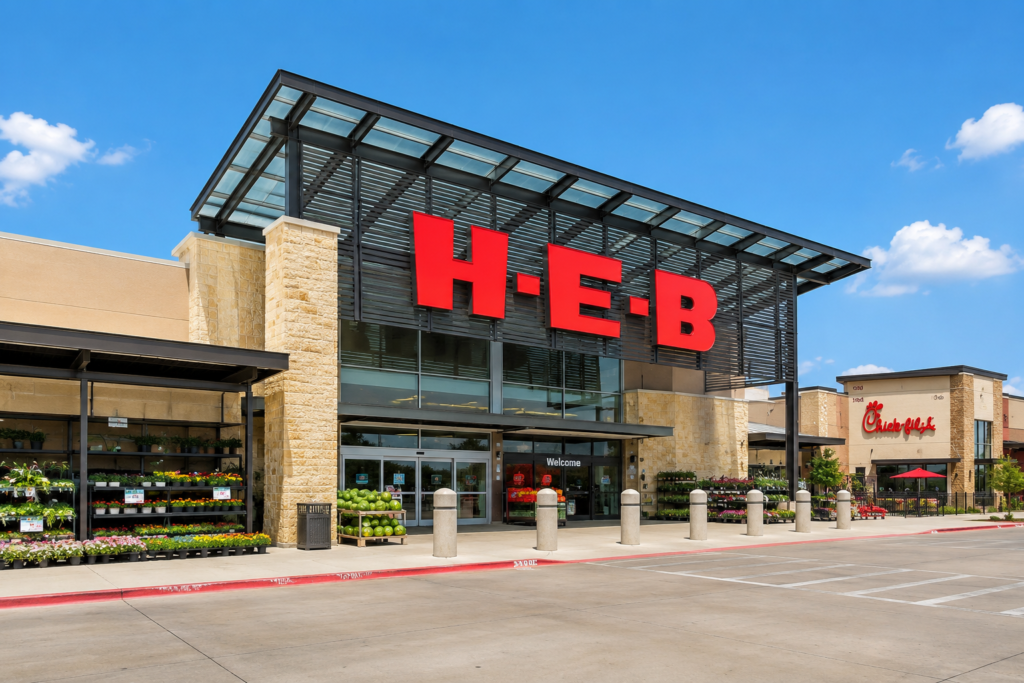
H-E-B doesn’t open stores randomly. Neither does Chick-fil-A. When either one announces a new Houston location, there’s a real estate thesis hiding inside that press release — and most people miss it entirely.
There is a running joke in Texas real estate circles that the fastest way to find a neighborhood about to appreciate is to follow the H-E-B trucks. It sounds like an oversimplification. It is also, in practice, one of the more reliable leading indicators available in the Houston market.
The H-E-B Effect is not a formal economic term. It is a pattern that Texas real estate professionals, investors, and observant homebuyers have noticed consistently enough that it now gets referenced in conversations the same way other market signals do. When H-E-B announces a new location, the surrounding area tends to see increased retail interest, complementary business formation, and — critically for buyers and investors — upward pressure on residential property values.
Understanding why requires understanding how H-E-B chooses where to build.
H-E-B Doesn’t Guess
H-E-B is famously methodical about site selection. The San Antonio-based company, which operates more than 435 stores across Texas and Mexico, conducts rigorous demographic analysis before committing to a new location — studying rooftop density, income trajectories, traffic patterns, population growth projections, and the competitive grocery landscape within a defined radius. They are not opening stores in areas they expect to stay flat. They are opening stores in areas they expect to grow.
When H-E-B announces or opens in a community, it sends a clear signal: this area has growth, rooftops, spending power, and long-term momentum. Major retailers do the kind of demographic and traffic analysis they do before they ever buy dirt — and H-E-B’s own expansion track record is a testament to how accurate that analysis tends to be.
There is academic research showing grocery store entry can increase nearby property values and can also encourage complementary businesses that further improve local amenities. It is a pattern — amenities attract demand, and demand supports value.
The psychological component matters as much as the economic one. Real estate is emotional and psychological. When buyers hear “new H-E-B coming” or “H-E-B just opened,” it creates a narrative — this area is going somewhere. And buyers pay more confidently when they believe the neighborhood is gaining momentum.
The Chick-fil-A Signal
H-E-B is the clearest example of this phenomenon in Texas but it is not the only one. Chick-fil-A operates one of the most rigorous site selection processes in the quick-service restaurant industry — the company famously rejects the vast majority of franchise applications and conducts years of market analysis before committing to a new location.
A recent example in Houston: Chick-fil-A opened a new drive-thru focused location at Washington Avenue and Yale Street in November 2025 — right in the heart of the Washington Avenue corridor that has been one of the most actively developing inside-the-loop strips in the city. A Chick-fil-A committing to a dense, walkable urban location like Washington and Yale is a vote of confidence in that corridor’s continued growth trajectory.
The pattern holds more broadly. When a Chick-fil-A appears in a suburban corridor — Katy, Pearland, Cypress, The Woodlands — it is not because the company picked a random intersection. It is because their site selection team looked at rooftop density trends, household income projections, and traffic count data and concluded that the area was worth a long-term investment. That is the same analysis a real estate investor should be doing.
What’s Currently in the Houston Pipeline
The H-E-B and Chick-fil-A expansion activity currently happening in the Greater Houston area offers a real-time map of where the smart retail money is pointing.
H-E-B is constructing a new Joe V’s Smart Shop in Houston with construction estimated to begin in May 2026 and finish in June 2027 at a cost of nearly $11.9 million — adding to the 11 Joe V’s locations already operating in the Houston area. Joe V’s specifically targets working-class and middle-income Houston neighborhoods with a value-price format, which means the new location is pointing toward a community H-E-B believes has sufficient residential density and spending power to support a full grocery operation.
H-E-B is also planning a new store in Montgomery, about 50 miles northwest of downtown Houston near Lake Conroe and the Sam Houston National Forest — estimated to complete in late summer 2026. The Montgomery location is the more interesting signal for real estate purposes. Montgomery is not a major suburban hub yet — it is a growing community in a corridor that has been absorbing Houston population spillover as buyers move northwest along Highway 105 for affordability and space. H-E-B committing to Montgomery is a strong indication that the company’s demographic models see continued population growth in that corridor.
On the Chick-fil-A side, the Washington and Yale location is the most notable recent Houston opening — a dense urban drive-thru format that signals the company’s confidence in the Washington Avenue corridor’s continued commercial momentum inside the loop.
How to Use This as a Real Estate Framework
The H-E-B and Chick-fil-A signal is most useful as a leading indicator rather than a lagging one. By the time a new store opens and the neighborhood has visibly improved, most of the appreciation has already happened. The opportunity is in identifying where the announcement has been made but the market hasn’t fully repriced yet.
A practical framework for Houston buyers and investors:
Watch the TDLR filings. The Texas Department of Licensing and Regulation requires construction permit filings before any major commercial build begins. H-E-B and Chick-fil-A filings show up in the TDLR database months before public announcements. If you see a filing for a new H-E-B at an intersection in a Houston submarket you’ve been watching, that is earlier-stage intelligence than waiting for the press release.
Identify the residential radius. The property value impact of a new grocery anchor is strongest within a half-mile to one-mile radius. Map that circle around the announced location and evaluate what residential product is available inside it at current pricing.
Look for the complementary retail cascade. A new H-E-B anchor almost always triggers a wave of secondary retail — coffee shops, fitness studios, fast casual restaurants, dry cleaners, urgent care centers — all of which further improve the neighborhood amenity base and support continued residential appreciation. The H-E-B is the first domino. Watch what follows it.
Separate the signal from the noise. Not every grocery store is H-E-B. A new discount grocer or a regional chain entering a corridor does not carry the same site selection rigor or market signal value. The H-E-B and Chick-fil-A signals are specifically valuable because of how demanding both companies are about where they open.
The Bottom Line
Houston’s real estate market is large enough and diverse enough that neighborhood-level signals matter enormously. The difference between buying in a corridor that is about to grow versus one that has already grown is often the difference between meaningful appreciation and buying at peak.
H-E-B and Chick-fil-A are not in the real estate business. But their site selection teams are doing the same demographic and growth analysis that smart real estate investors do — and they are doing it with more data and more resources than most individual buyers have access to. When either company plants a flag in a Houston corridor, paying attention to that signal is not a gimmick. It is one of the more reliable pieces of public information available about where the market is heading next.
The trucks usually know before anyone else does.