New construction in Houston comes with a premium, a MUD tax, an HOA, and a builder’s lender who works for the builder — not you. Here’s what to know before you sign anything.
The model home is always beautiful. The sales rep is always helpful. The builder’s preferred lender always has a rate that sounds competitive. And the community always has amenities that make the subdivision feel like a resort until you are actually living there and the lagoon maintenance fee shows up on your HOA statement.
New construction in Houston is genuinely appealing — clean finishes, builder warranties, no deferred maintenance, modern energy efficiency. For the right buyer in the right situation, it is absolutely the right call. But for buyers who do not understand the full cost structure of Houston new construction, it is also one of the most expensive mistakes available in the local real estate market.
Here is what to know before you set foot in a model home.
The Premium Is Real and It Is Larger Than You Think
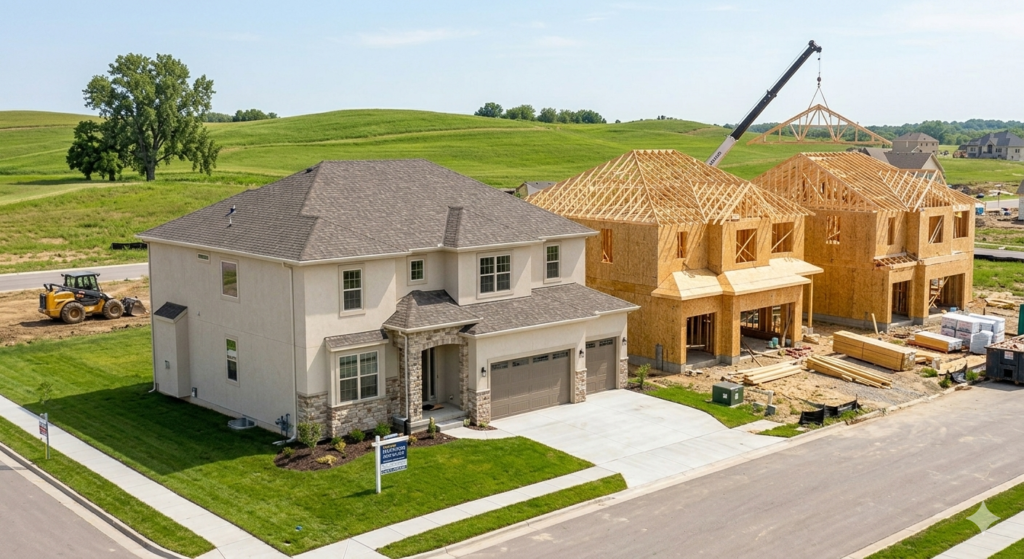
New construction homes in the Greater Houston area typically carry a 10% to 20% price premium over comparable resale properties. A standard 1,700-square-foot home in a developing area like Cypress or Pearland might list for approximately $325,000 as a new build, while a similar resale home in an established nearby neighborhood might be listed for around $300,000.
That $25,000 gap is just the beginning of the math. The more important number is the total effective cost of ownership when you add the elements that the builder’s marketing materials tend not to emphasize.
The MUD Tax — The Number Most Buyers Never See Coming
Municipal Utility Districts are the financing mechanism that built most of Houston’s master-planned communities. When a developer builds infrastructure — water, sewage, drainage, roads — in a previously undeveloped area, they often do it by forming a MUD that issues bonds to pay for the infrastructure. Homeowners in the MUD repay those bonds through a special tax rate added on top of their standard property tax.
MUD tax rates can be 2 to 3 times higher than non-MUD areas, adding $500 to $800 or more per month to your payment. An online mortgage calculator that uses a default 2.0% tax rate will underestimate your payment by $200 to $500 per month if you are buying in a MUD area.
In developing areas, total tax rates including the MUD can sometimes exceed 3%. On a $400,000 home, the difference between a 1.8% effective tax rate and a 3.0% effective rate is $4,800 per year — $400 per month that does not appear in the builder’s payment estimate unless you ask specifically.
The MUD tax does decrease over time as the bonds are paid off. MUD rates in new developments often start high and decrease over time — which is important for future resale value. But for the first 5-10 years of ownership, the MUD tax is a real and significant additional cost that changes the affordability math substantially.
Specific examples: Cinco Ranch carries a MUD rate of approximately $0.45 to $0.55 with a total tax rate around 2.9%. Cross Creek Ranch carries a MUD rate of $0.80 to $0.90. Those rates matter when you are comparing a new home in Cross Creek Ranch to a resale home inside the loop with a 1.8% effective rate.
The Builder’s Incentives Are Not Free
Because inventory has remained tight, national and local Houston builders are offering aggressive incentives including mortgage rate buydowns — effectively giving buyers a lower rate for the first few years — and $10,000 to $15,000 in closing cost assistance if you use their preferred lender.
The preferred lender incentive is where buyers consistently leave money on the table. The builder’s preferred lender works for the builder. Their job is to close transactions, not to find you the best loan terms. The closing cost credit they offer frequently costs you more over the life of the loan in a slightly higher interest rate than you could have negotiated independently. Always get an outside loan quote before agreeing to use the builder’s preferred lender — even if it means forgoing some of the credit.
The builder’s sales rep also works for the builder. Their preferred lender works for the builder. You need someone on your side for both the deal and the financing. A buyer’s agent representing your interests costs you nothing in new construction — the builder pays the commission — and provides a meaningful check on the sales process.
The Depreciation Curve Nobody Talks About
New construction depreciates from day one in a way that established home inventory does not. In high-supply suburban submarkets where builders are continuously delivering new product, the resale value of a two-year-old home competes directly with new homes that have updated finishes, current builder incentives, and warranty coverage.
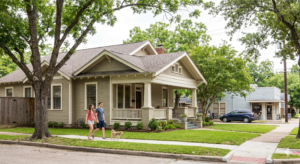
The inner-loop resale market does not have this problem because land scarcity limits new supply. A well-located resale property in the Heights or Montrose appreciates against a constrained supply backdrop. A new construction home in Fulshear or Hockley appreciates against a backdrop of continued builder activity that keeps pricing anchored near construction cost.
The hold period matters enormously. If you plan to stay in the property for 7-10 years the new construction premium and MUD tax normalize over time and the appreciation story can work in your favor. If you are buying with a 3-5 year horizon, the combination of purchase premium, MUD tax, HOA fees, and the depreciation curve relative to continued builder supply makes the math significantly harder.
When New Construction Does Make Sense
This is not an argument against new construction universally. There are clear cases where it is the right decision.
If school district is your primary driver and the best districts are in suburban master-planned communities with active builders, new construction may be the only way to access the product you need. If you want a warranty, modern energy efficiency, and no deferred maintenance for the first several years, the premium for new construction has genuine value. If builder incentives in the current market are substantial enough to effectively offset the MUD tax impact — some 2026 builder rate buydowns are meaningful — the total cost calculation may favor new over resale.
The mistake is not buying new construction. The mistake is buying new construction without understanding the full cost structure — the MUD tax, the HOA fees, the preferred lender trap, and the supply-side constraint on appreciation — before you sign the contract.
The master-planned communities in Katy, Cypress, and The Woodlands that attract thousands of families every year were largely built using MUD financing. Those communities are genuinely excellent places to live. They are also places where the monthly cost of ownership is meaningfully higher than the builder’s payment estimate suggests — and where buyers who do not do their homework end up surprised in year two when the real number hits.
Do the math on the full effective tax rate before you fall in love with the floor plan.