After decades of sprawl-first development, Houston’s mixed-use market is hitting an inflection point. Here’s what’s being built, where, and why it’s different this time.
Houston has always been the city that builds outward, not upward. Car-dependent by design, spread across 670 square miles, with no zoning code to force density. But something is shifting. A new generation of Houstonians wants to walk to dinner, work downstairs from where they sleep, and live in neighborhoods with actual street life — and developers are finally building for them. The pace of walkable mixed-use development in Houston right now, according to people actively working in the market, is off the charts.
What “Walkable Mixed-Use” Actually Means in Houston
In cities like New York or Chicago, walkable mixed-use is the default. In Houston, it’s a deliberate bet against the city’s own DNA.
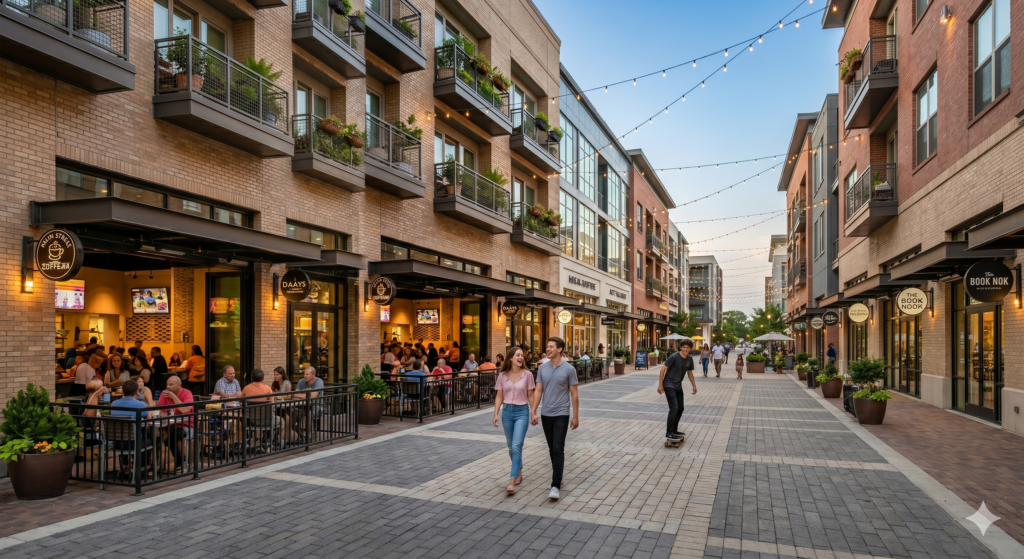
The model is simple: stack residential units above or adjacent to retail, restaurants, and office space, reduce surface parking, and design streets for people instead of cars. In most American cities, zoning codes either mandate or prohibit this. Houston, famously, has neither — which means walkable mixed-use development here is entirely market-driven. When it happens, it’s because a developer genuinely believes people will pay a premium to live, work, and spend within walking distance of each other.
That belief is now showing up everywhere you look.
Houston’s City Council has also been quietly building the regulatory infrastructure to support it — three pilot areas are currently testing new transit-oriented development standards along Emancipation Avenue in the Third Ward, Midtown, and Hogan Street in the Near Northside, applying to streets within a half-mile of METRORail stations and high-frequency bus routes. Zoocasa
The Projects Leading the Charge
The clearest signal that Houston’s walkable mixed-use moment has arrived is the sheer number of projects either underway or recently delivered. These aren’t renderings. They’re being built right now.
East Blocks — EaDo
East Blocks is a 10-block mixed-use district in EaDo developed by Pagewood. Phase 1 broke ground recently and is expected to complete by August 2026 — timed almost perfectly with the FIFA World Cup Fan Festival, which will take place just steps away. The development converts the site’s former railways into four city blocks of green space connecting revitalized warehouses, with retail, restaurants, and office space woven throughout. Phase 1 alone will deliver nearly 513,000 square feet of mixed-use space, including 196,000 square feet of retail and restaurants and 112,000 square feet of offices. A walking and biking loop will connect the district to Downtown and the Columbia Tap trails running through the East End. Existing anchor tenants 8th Wonder Brewery and Pitch 25 are staying. HoustonBisnow
East River — EaDo/Buffalo Bayou
East River is a 150-acre mixed-use development on the banks of Buffalo Bayou that has already opened, delivering office, restaurant, and retail space alongside a 360-unit apartment complex and East River 9, a nine-hole golf course and restaurant concept. Developed by Midway, it is one of the largest walkable mixed-use bets ever made in Houston — and so far, the market has responded. Houston
The Plant — Second Ward
The Plant is a 17-acre mixed-use district that will revamp the historic streets of Second Ward into a pedestrian-friendly district lined with restaurants and shops. It sits just east of Downtown and is part of a broader wave of development reshaping Houston’s inner East End into something that looks nothing like it did five years ago. Houston
Park Eight Place — Westchase
Johnson Development is transforming the former Halliburton campus in the Westchase District into Park Eight Place, a $1 billion, 70-acre walkable mixed-use destination featuring residential, retail, hotel, and office space with access to the adjacent 200-acre Arthur Storey Park. It is set to become Houston’s first developer-initiated Walkable Place — a designation granted by Houston City Council to promote pedestrian-friendly urban development. Houston
Greenside — Memorial City
Greenside is taking shape in Memorial City as a new mixed-use destination converting former warehouse space into a 35,000-square-foot retail complex anchored by outdoor gathering areas, with an acre of green space surrounded by restaurants, retail, wellness, and office tenants. It is slated to open in 2026. Houston
Central Park Post Oak — Uptown
The Central Park Post Oak complex is expanding with a mixed-use redevelopment adding more than 150,000 square feet of new retail and restaurant space in Uptown, with two new buildings along Post Oak Boulevard and a central green space replacing the existing office lawn. Houston
Downtown — Main Street 2.0
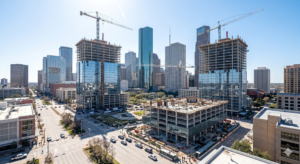
Downtown Houston is undergoing one of its most dramatic transformations in decades, driven largely by World Cup preparations. The centerpiece is “More Space: Main Street 2.0,” which is converting 11 blocks of the central business district into a permanent, vehicle-free pedestrian promenade with outdoor rooms that shift between cafe seating, public programming, and pop-up retail. The GreenStreet redevelopment is also transforming traditional mixed-use space into pedestrian-friendly alleyways. Zoocasa
Who’s Driving the Demand
The demographic story behind Houston’s walkable mixed-use moment is straightforward: younger professionals who grew up in denser cities or traveled enough to know what walkable feels like are choosing neighborhoods that offer it — and paying more for the privilege.
EaDo is transitioning from an industrial district into an entertainment and residential hub. Midtown remains more affordable than Montrose or the Heights, making it a popular landing spot for young professionals seeking walkability without the premium price tag. Zoocasa
But it isn’t just millennials. Empty nesters downsizing from large suburban homes, international residents accustomed to urban living, and young families who want to walk to school, coffee, and groceries are all showing up in the same zip codes. The demand is broad enough that developers are no longer treating walkable mixed-use as a niche product. It is becoming the mainstream bet for inner-loop Houston.
The Obstacles That Are Still Real
Houston’s walkable future isn’t inevitable. There are structural challenges that don’t disappear just because the market wants something different.
Parking requirements remain one of the greatest challenges. Nobody wants surface parking in front of buildings as they walk, but building parking garages behind buildings is expensive. EaDo and parts of Midtown have benefited from Houston’s market-based parking exemptions, which were extended beyond Downtown in 2019 — but those exemptions don’t apply everywhere. Bisnow
The heat is real too. Houston summer temperatures push people toward cars and away from sidewalks in ways that most walkable city comparisons don’t account for. Developers are compensating with covered walkways, shaded green spaces, and activated ground floors that make the experience worth the sweat — but it remains a genuine design challenge that northern cities don’t face.
Infrastructure gaps — sidewalk connectivity, transit frequency, bike lane continuity — are still inconsistent across the inner loop. You can build the most walkable block in Houston, and two blocks away there’s no sidewalk at all.
What the Next Five Years Look Like
The pipeline suggests the shift is accelerating, not slowing. The World Cup is catalyzing projects that will outlast the tournament by decades — Main Street 2.0 is permanent, East Blocks is a 20-year bet on EaDo, and the city’s new transit-oriented development standards are creating a regulatory framework that didn’t exist three years ago.
For investors and developers, the window to get ahead of this trend is narrowing. Land values in EaDo, Midtown, and the Second Ward have moved significantly in the last 24 months. The neighborhoods that look undervalued today relative to their walkable mixed-use potential — parts of the Near Northside, Third Ward along Emancipation, and certain blocks of the East End — are where the next round of bets is being placed.
Houston isn’t becoming Manhattan. It isn’t even trying to. It’s becoming something distinctly Houstonian — a sprawling city with a growing number of walkable nodes that people choose to live in, work in, and spend money in. That’s a different city than the one that existed ten years ago. And the real estate market is pricing it in.
The HTown Insider covers Houston commercial real estate, development, and the neighborhoods being shaped by both. For more CRE coverage, visit the Real Estate section.